How to Steam Dumplings in a Bamboo Steamer Without Sticking
Sticking is the complaint we hear most about dumplings in a bamboo steamer. The skin tears on the way out, the filling spills, and half the batch lands on the plate looking like it lost a fight.
It is fixable, and it is not about technique or expensive equipment. Three separate things cause dumplings to stick, and each one has its own answer.
Three reasons dumplings stick
The slats. Bamboo bases are built with gaps so steam can pass through, and the gaps run about 8 mm wide. A wet wrapper pressed onto those gaps squeezes into them slightly, and once the starch sets, it has locked itself around the bamboo.
The moisture. A dumpling fresh from the wrapper is damp on the underside. That dampness is what turns into glue under steam.
The movement. A hard boil throws water against the base and the dumplings shuffle. Every shuffle is a chance for a skin to tear before it has firmed up.
Deal with all three and dumplings lift off cleanly. Deal with two and most of the batch survives, which is somehow more annoying than losing the lot.
What to put under them
Nothing sticky should touch bare bamboo. That is the whole rule.
Parchment is the most reliable liner. It releases cleanly, it is cheap, and it works with any filling.
Muslin or cheesecloth is the traditional answer, and it is better for anything with a delicate skin. Wet it, wring it out until it is barely damp, and lay it flat so there are no folds.
Cabbage leaves and corn husks are the oldest option, and the only ones you can eat afterwards. They also add a little aroma, which matters if the dumplings are sitting next to something sweeter.
Banana leaf works the same way in Southeast Asian kitchens, and it is wide enough to cover a twelve inch base in one piece, which muslin is not.
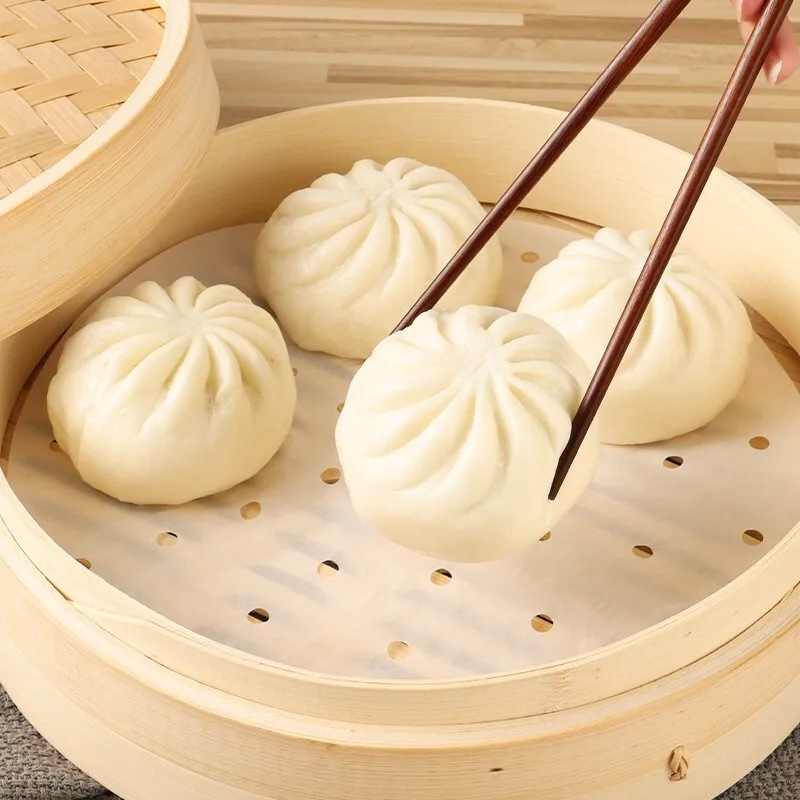
If you use parchment, punch the holes
This is the part people skip, and then wonder why the bottoms are gummy.
A solid sheet of paper traps steam underneath it. The paper lifts slightly, water pools between paper and slats, and the dumpling sits in a puddle instead of over steam.
Fold the sheet into quarters, snip the folded corner off, then unfold it. One cut gives you a hole in the centre. Three or four more snips around the edge and the steam has somewhere to go.
Cut the sheet 2 to 3 cm wider than the basket base, so the edges turn up slightly and nothing slides off.
Spacing: the number that decides everything
Dumplings should not touch each other, and they should not touch the rim. Steam has to move around each one, and a dumpling pressed against its neighbour has nowhere to expand.
A ten inch tier takes 15 dumplings laid flat, which is the number most takeaway orders are built around.
If they are touching, you have too many. Drop to the next tier rather than crowding the tray, because a crowded tray gives you torn skins and pale, underdone centres at the same time.
Count by eye rather than by weight. If the tray already looks full, it is, because the space a dumpling needs around itself is the space the eye discounts first.
Fresh or frozen, and why it changes things
Frozen dumplings go in straight from the freezer. Thawing them first is the single most common cause of sticking, because a thawed wrapper is wet, soft and already halfway to glue.
Give frozen ones two to three minutes more than fresh, and leave a little more room between them. Frozen food releases water as it heats, and that water has to go somewhere.
Keep the boil under control
A rolling boil is the enemy here. It throws water against the base, it rattles the basket, and it moves the dumplings around while their skins are still soft.
Bring the pot to a boil, set the basket on, then turn the heat down to a steady simmer. Steam should rise evenly from the whole seam, not blast out of one side.
If you can hold a hand near the seam for a second, the heat is right. If you cannot, it is too high.
Getting them out without tearing
Turn the heat off and wait thirty seconds. The skins firm up in that half minute, and it is the cheapest improvement available.
Lift with a flat tool, not tongs. A thin spatula or a bamboo slice goes underneath and takes the whole dumpling. Tongs squeeze, and a squeezed dumpling bursts.
Work from the outside in. The ones at the edge are always looser than the ones in the middle.
If a dumpling resists, slide the tool under it rather than pulling. Pulling tears the skin even when the base has already released.
Keep a small bowl of water and a clean cloth beside the steamer. Wiping the tool between lifts stops one torn dumpling from dragging starch onto the next.
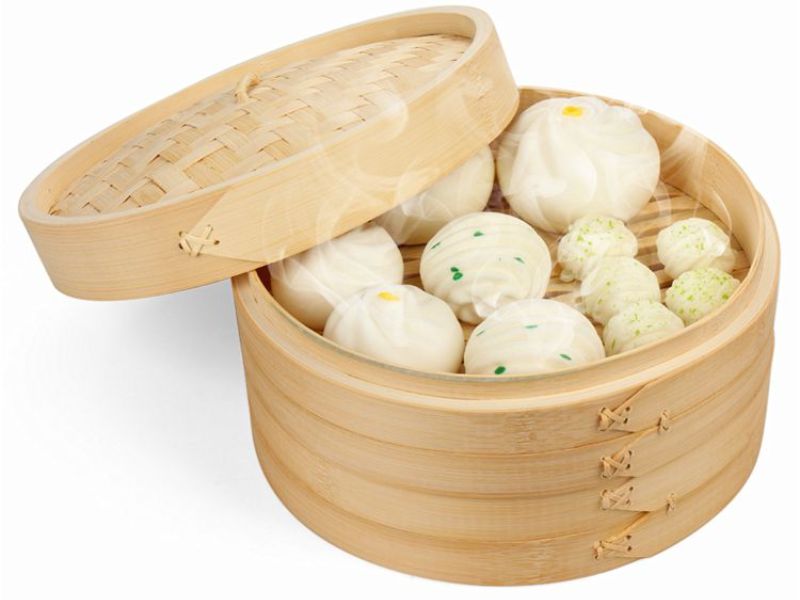
Soup dumplings need their own approach
Soup dumplings, the xiao long bao kind, carry liquid inside a thin skin, which makes every problem above worse.
Do not use perforated paper for them. The skin is soft enough to take a mark from the paper, and the holes give the base somewhere to sag into. Wet muslin or a cabbage leaf is the safer option.
Give them more room than an ordinary dumpling. One that touches its neighbour tears as it is lifted, and the soup goes with it.
Ten minutes is the usual window at ten inch. Past that the skin starts to collapse around the filling.
Lift them with a spoon that supports the base rather than a spatula. The weight sits in the liquid, and a thin edge of steel will cut straight through it.
When they still tear
A thin wrapper tears under its own weight once the filling heats and expands. If the same recipe fails twice, the wrapper is the problem, not the steamer.
A wet filling leaks, and leaked liquid glues the dumpling to whatever is under it. Drain the filling before wrapping, or add a little more starch to bind it.
Over-steaming softens the skin until it cannot hold. Two minutes past done is enough to turn a clean lift into a tear.
Too many per tier, as covered above. Crowding is the most common cause and the easiest to fix.
A European distributor passed this back to us from a customer who had loaded a single tier well past its capacity. Every dumpling was touching its neighbour, and most of the batch came apart at the lift. Nothing was wrong with the basket.
In a service kitchen, the practical version of all of this is two sets of baskets. One steams while the other is lined and loaded, which also solves sticking, because dumplings go onto a dry liner rather than a wet reused one.
Clean up before the starch sets
Rinse the basket with hot water while it is still warm. Once dumpling starch dries into the weave it takes a brush and patience to get out.
No detergent, no soaking. Stand the rings up to dry, and the basket is ready for the next batch.
For the fuller picture on water level, heat and tier loading, see our guide to using a bamboo steamer.
If you are buying for a dumpling kitchen rather than a home steamer, our ten inch baskets are built to stack flat with the same rim height batch to batch.