What Is a Bamboo Steamer Basket? Tiers, Sizes and What It Does
Most bamboo steamer baskets arrive in a kitchen the same way. Someone buys one for a single recipe, a batch of dumplings or a first attempt at bao.
Then it sits on top of the fridge for a year, because nobody explained what it is actually good at.
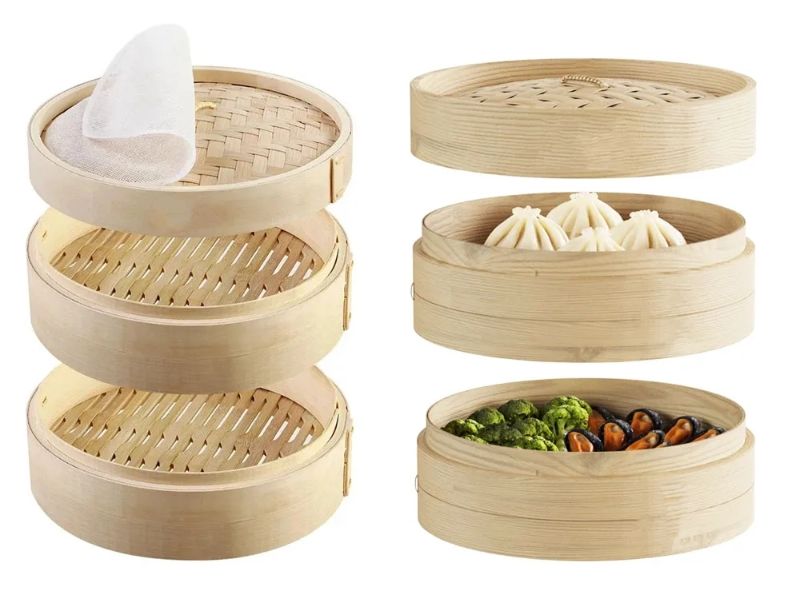
A bamboo steamer basket is a stack of shallow bamboo hoops, each with a slatted or woven base, closed by a domed lid. It sits over boiling water. It never touches the flame or the element. All it gets is steam.
People also call it a bamboo steam basket, a bamboo food steamer or simply a steamer basket, and all of those names describe the same object.
That is the whole machine. Everything else is detail. How the hoops are bound, how wide the gaps in the base run, whether the lid seats inside the rim, and what the bamboo does to itself after a hundred cycles of steam and drying out.
It does three jobs, not one
Most people treat a steamer as a container. It is closer to a piece of equipment with three jobs, and the three pull against each other.
The first job is spreading steam. Steam leaving a pot rises in a column, hottest and fastest in the middle.
A stack of hoops breaks that column up and lets it move sideways, so a tray near the top of a three-tier stack cooks at something close to the rate of the tray at the bottom.
Close, not identical. The bottom tier is always hottest, which is why experienced cooks put the item that needs the longest time down there.
The second job is controlling condensation. This is where metal steamers struggle.
A steel or glass lid stays cool at the crown, water condenses on the inside, and at some point a drop falls onto whatever is underneath. On a proving bun that drop leaves a gray, chewy patch that no amount of steaming fixes.
Bamboo takes that water into the weave of the lid instead of letting it hang above the food.
The third job is aroma. Bamboo holds the smell of what it steams.
Some cooks chase this deliberately and lay tea leaves or a strip of kombu in the water so the basket picks up the scent.
Others hate it, because a basket that steamed fish on Friday will taste of fish in a custard bun on Sunday. Both reactions are fair. The material does not filter.
What happens inside, in plain terms
Steam carries far more heat per gram than hot air, and it gives that heat up when it condenses on something cooler than itself.
Put cold dough in a basket and steam condenses on the surface, releasing heat right there. That is why steaming cooks the outside of a bun in seconds.
Bamboo slows that down slightly, and in a useful way. The strip is a poor conductor compared with steel, so the walls of the basket do not blast heat into the edge of the food.
The result is a gentler cook, fewer split tops, and a surface that stays glossy instead of drying to a skin.
Bamboo also breathes. Moisture moves into the strip, through it, and out again as the basket cools. A steel basket has nowhere to put that water, so it runs down the inside wall and pools at the base.
What you can actually steam in it
Almost anything that cooks in moist heat, and a few things that would rather not.
Dumplings are the entry point. Fresh wontons take six to eight minutes. Frozen ones take longer and should not be thawed first, because a thawed wrapper tears the moment it meets steam.
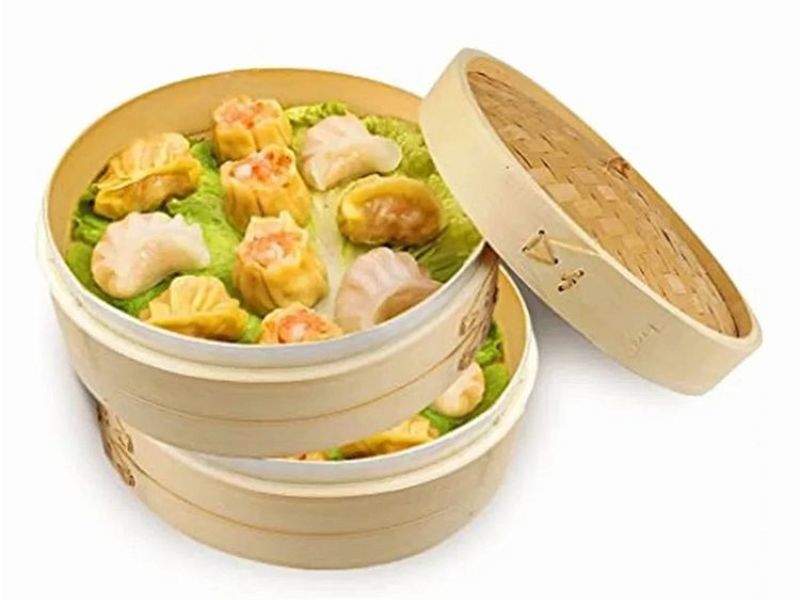
Gyoza and xiao long bao behave the same way. Soup dumplings need a liner, or a cabbage leaf, so the skin does not weld itself to the slats.
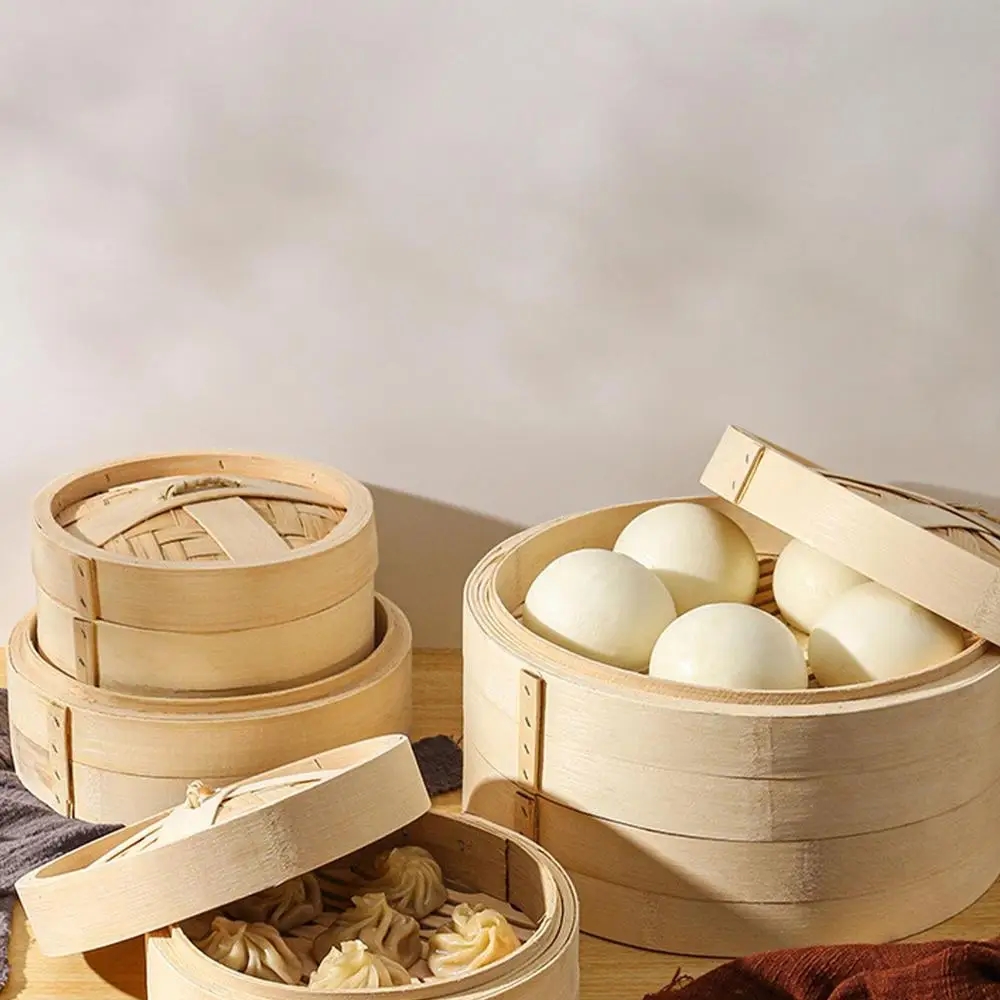
Bao and other yeast buns are the second reason people buy a basket at all. They need warm, humid air and a lid that does not drip, which is exactly what bamboo provides and exactly what a steel lid fails at.
Vegetables are the most underrated use, and the one that justifies leaving the basket on the counter instead of in a cupboard.
Broccoli, cauliflower, asparagus, green beans, sliced carrot, whole baby pak choi. They come out with more color and more bite than boiling gives them, and nothing leaches into the water.
Sticky rice and glutinous rice are traditional, but they need a liner and a longer time. Loose grains fall straight through the slats, so the base gets lined with muslin or a banana leaf first, and the rice is soaked before it goes in.
Fish and shellfish work if the basket is wide enough. A whole sea bass wants twelve inch. Prawns want any size but only three or four minutes. Clams go in a shallow dish so the liquor is kept.
Fish is also the one food that leaves its smell in the bamboo for weeks. If you steam fish regularly, keep a dedicated basket for it. There is no cleaning routine that removes fish oil from bamboo strip.
Dim sum service is the commercial version of all of the above, and it is the reason ten inch became the standard diameter. One tray holds four dumplings, or six if they are small.
How the tiers stack
A standard basket is a bottom ring, one or more middle rings, and a lid. Set them up carelessly and the whole stack leaks steam at every joint.
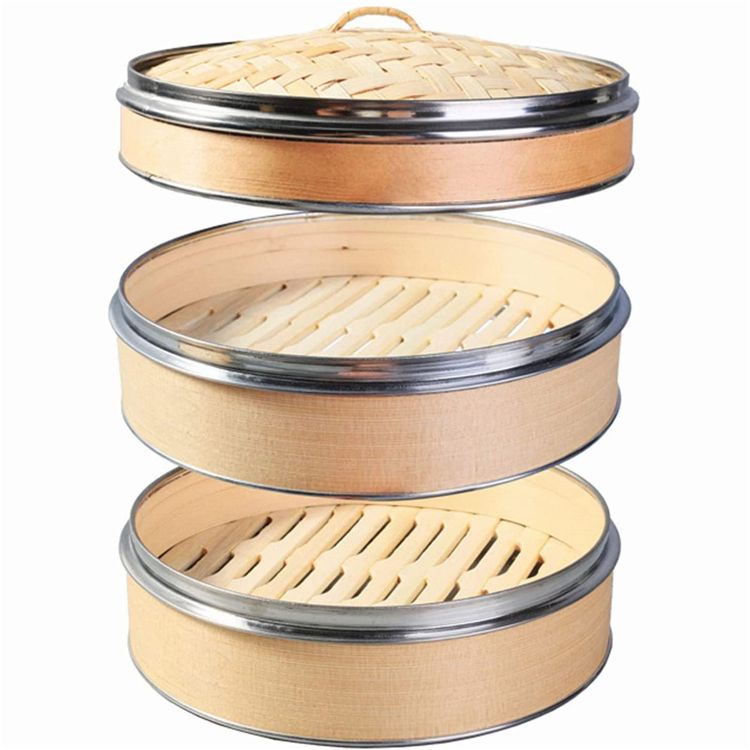
Each ring has a bound rim at the top and a step at the bottom, so the ring above drops into it. That joint is where the work happens.
When it seats properly the stack is close to sealed. When it does not, steam escapes sideways at the seam, the upper tiers cook slowly, and the difference between the bottom and top tray becomes obvious on the plate.
A European distributor raised this on a delivery. The rings seated, but not firmly, so the stack rocked whenever a full basket came off the pot. Steam found the joints and the top tier came out pale.
The lid follows the same logic, and this is where cheap baskets reveal themselves. On a good basket the lid sits down inside the top rim, with the woven face below the edge.
On a cheap one the lid rests on top like a plate on a bowl, and steam pushes out around the full circumference.
Adding tiers gives capacity, not speed. Three rings over the same pot means more food, a longer recovery time every time you lift the lid, and a weaker cook at the top.
For a home kitchen, two rings is usually the sensible ceiling.
A dim sum service runs four or five because throughput matters more than perfect evenness, and because a commercial steamer sits over a much larger water surface with a much stronger boiler underneath.
What it is actually made of
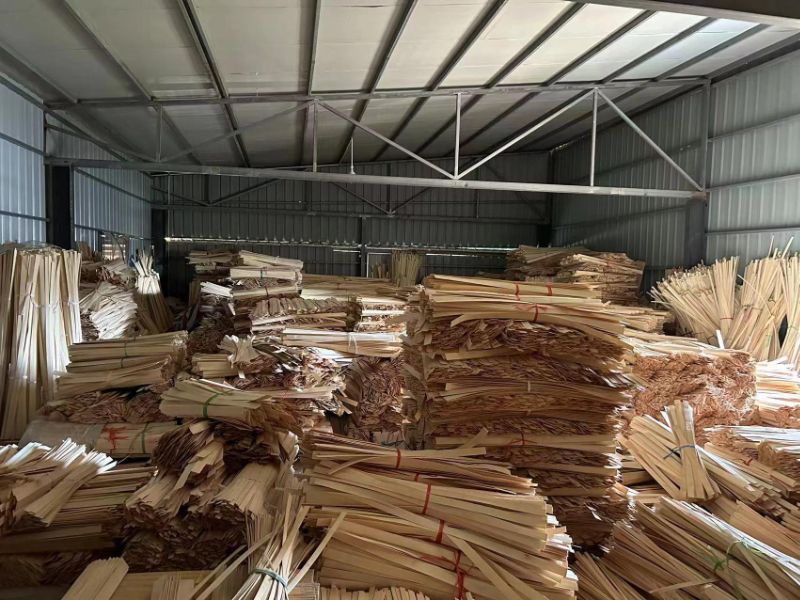
The material is bamboo strip, not bamboo board. Culms are split lengthwise into strips a few millimeters thick, then shaved so the outer face keeps its skin and the inner face stays soft.
That difference matters. The skin side resists water. The soft side grips the food less.
The outer ring is usually two strips, one inside and one outside, clamped together and pinned. Look for the pins on a real basket: three or four small bamboo dowels driven through the rim at an angle, with the ends trimmed flush.
Those pins are the difference between a rim that holds its circle for years and one that starts to sag on the third wash.
The base is either woven or laid in parallel slats. Woven bases look better and drain faster. Parallel slats are stronger and cheaper, and they are what most commercial baskets use.
The binding is cotton or rattan thread, and on the rim it is often doubled. That edge takes the load every time you lift a full basket off the pot.
An under-bound rim goes soft long before the body does, and once it deforms the basket stops sitting flat.
Sizes, and matching the pot
Bamboo steamers are sold by diameter in inches. The numbers are inherited, so a 10 inch basket measures about 25 cm across, not 25.4 cm of anything precise.
Six inch (about 15 cm) is one or two people. A few dumplings, a small plate of greens, a single bun.
Eight inch (about 20 cm) is the home workhorse. Two tiers feed four people without stacking food on top of food.
Ten inch (about 25 cm) is the commercial standard for dim sum and one of the sizes we ship most. It is also the 10 inch two-tier basket most kitchens start with.
Twelve inch (about 30 cm) is for whole fish, large batches of bao, and stalls that need volume rather than precision.
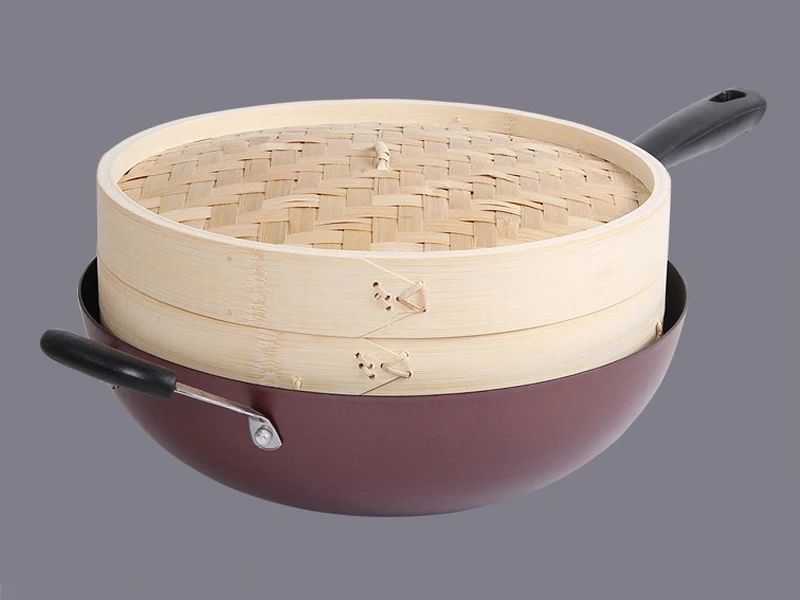
The mistake almost everyone makes is buying the basket before measuring the pot. A steamer should sit level, either just inside the mouth of the pot or on a rack above the water.
If the basket is much narrower than the pot, steam escapes around the outside and the cook is slow and lopsided. Too wide and it will not sit at all.
Measure the pot mouth first, then buy the basket that matches it, not the other way round.
Water level matters just as much. Water should sit below the base of the bottom tier and never touch it. Dough sitting in water does not steam. It poaches, and the base goes dense and gray.
Bamboo against stainless steel
Both work. They fail differently.
Stainless steel is faster to clean, survives a dishwasher, does not mold, and will outlast several bamboo baskets. It also drips.
That is not a small point when buns are involved, because one cold drop on a proving bun leaves a mark that cannot be repaired. Steel is hot at the rim, and it holds no aroma at all.
Bamboo is light, cool to handle, absorbs condensation, and carries a smell that most people who grew up with steamed buns expect. It also absorbs everything else, fat and fish oil included, and it will grow mold if it is put away wet.
There is a third option that gets less attention. A stainless ring with a bamboo lid and a bamboo slatted base.
The durability sits where the abuse is, on the body, and the bamboo sits where it actually does something, at the lid where condensation forms and at the base where steam passes through.
Kitchens that steam hard all day and still want the buns to come out with an unmarked skin tend to end up here. That hybrid is the version we build for kitchens running steam from open to close.
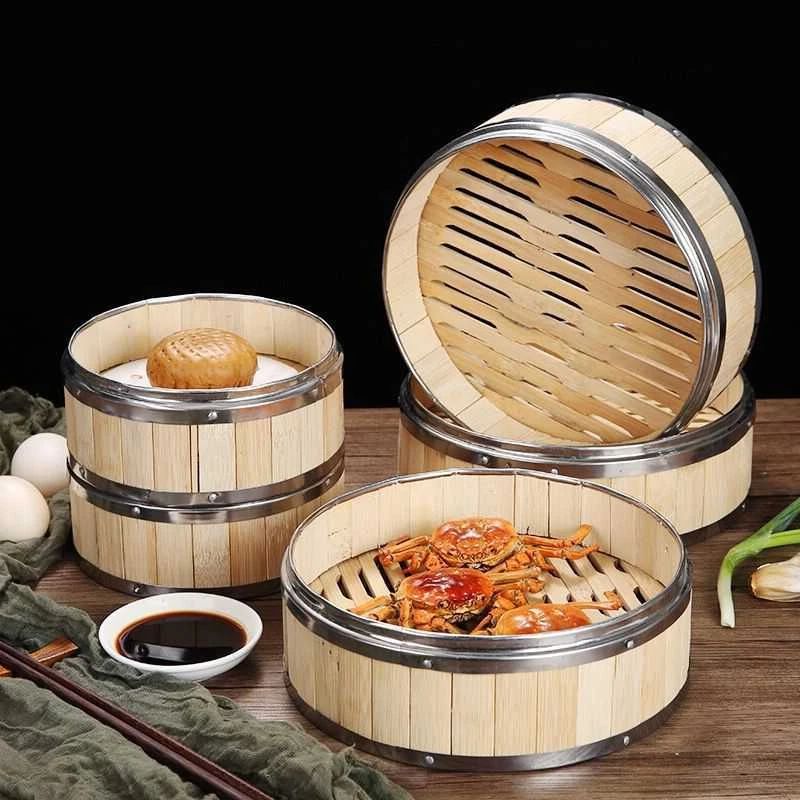
Wooden steamers, the tall bucket shape used for bread and rice, are a separate tool. They hold more heat and more moisture, they are heavier, and they are poor at small batches.
Rattan baskets, the coiled kind used for bread proofing, are not steamers at all. They hold dough at room temperature and would soften in a steamer.
Where bamboo falls short
There is no point pretending the material is perfect.
Mold is the first failure, and it is almost always caused by storage rather than by the basket. A basket washed and stacked while still damp will have gray fuzz in the weave within two days in a warm kitchen.
One buyer did exactly this: washed a full set, stacked it wet, and found gray fuzz in the weave a few days later.
They dried the batch in the sun, brushed it out, and kept using it. Most mold complaints end that way. The basket survives, the routine changes.
Cracking is second. Bamboo moves with humidity. A basket stored next to a radiator, or in a dry air-conditioned room, will open hairline splits along the rim, and those splits catch food and hold it.
Odor transfer is third. Curry, garlic, fish and anything with chilli oil stay in the strip for months.
Staining is fourth. Turmeric turns a pale basket orange in a single session, and it does not come back.
Then there is the dishwasher question. Bamboo is not dishwasher safe, whatever the listing says. Heat and prolonged soaking break down the binding and warp the rings, and the basket will not stack squarely again.
Finally, lifespan. A home basket used twice a week and dried properly lasts two to three years.
A commercial basket in daily service lasts far less, and most kitchens replace rather than repair, because a basket that does not seat is a basket that ruins service.
Care that actually works
Rinse with hot water and a soft brush while the basket is still warm, before anything dries on. Avoid detergent where you can, because the strip absorbs it and gives it back to the next batch of buns.
Never soak, and never put bamboo in a dishwasher. Ten minutes in a sink undoes a week of careful drying, and heat plus soaking loosens the binding at the rim first.
Dry it standing up, rings separated, in moving air. Stacking damp baskets is how mold starts, and mold is the failure that ends a basket's life early.
For mold that has already appeared, wipe with dilute white vinegar, rinse, and dry in the sun.
Do not put bamboo in an oven to speed it up. The strip will cup and the rim will open.
What to check before you buy
Pins flush with the rim. A pin standing proud catches a cloth and pulls out within weeks.
A doubled rim, not a single strip folded over.
A lid that sits inside the top ring, not on top of it.
Even gaps in the base. Wide patches let dough bulge through and tear on the way out.
Rings that stack without rocking. Put the basket together and press the rim. Any movement means steam will find it.
Matching diameters across a set, if you are buying more than one. Mixed stock from mixed suppliers is the usual reason a stack of five does not sit flat.
Test reports are available on request, if the purchase is for a business rather than a home kitchen.
Who ends up using one
Home cooks who steam once a week and want the buns to look like the ones they buy. Dim sum kitchens that stack five high and replace baskets by the crate.
Tea houses, hot pot restaurants and bakery counters that use steam to refresh bread before service.
Importers and private-label buyers who need the same basket, at the same diameter and the same rim height, in every shipment.
If you are buying by the container rather than the unit, our bamboo steamer basket range is built to one diameter and one rim height, so a stack of five seats flat and every shipment matches the sample.
Samples go out before any bulk order, so a basket can be tested over your own pot first.
The basket itself has not changed much in a very long time, and that is the point.
What changes between a good one and a bad one is the strip thickness, the binding at the rim and the drying routine the owner follows. Those three decide whether the thing in your cupboard is still usable in two years.